
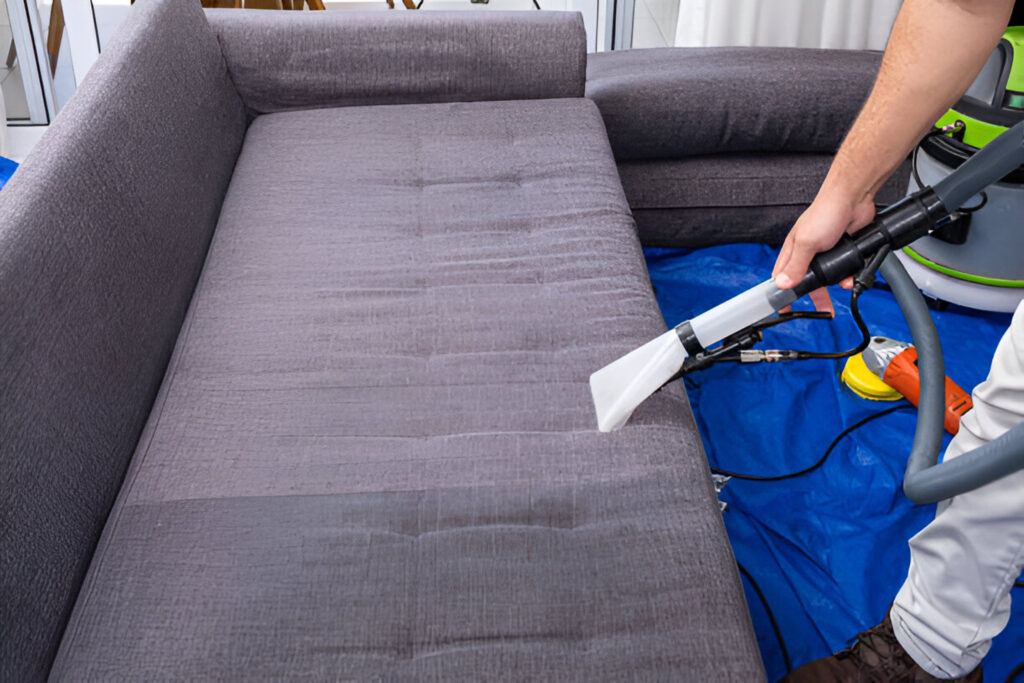
Sofas are an indispensable component of your residence. You employ these to watch television with your family or to recline down and take a brief snooze. Sofas are frequently soiled and filthy due to their frequent use.
There are numerous factors that can cause a settee to become filthy, including coffee spillage, chip fragments that fall into the crevices, debris tracked by canines and popcorn kernels that become confined between the cushions and spaces.
It is imperative to maintain the cleanliness of a settee fabric in order to ensure that it remains fresh and durable for an extended period. Surface-level cleaning of your couch is advised by experts every 2-3 weeks, while extensive cleaning is advised every 4-6 weeks.
However, the issue remains: how should one approach the task of cleansing this costly piece of furniture? There are numerous factors to consider when cleaning a sofa in Dubai, as it is not the same as cleaning ordinary fabric, according to expert sofa cleaning services. However, there is no need for concern, as this article is dedicated to this subject.
The following are a few straightforward methods to sanitize a settee at home:
• Examine the cleaning tag provided by the manufacturer.
• Procedures for Cleaning Microfiber and Fabric Sofas
• Procedures for Cleaning Leather Sofas
• Procedures for Cleaning Velvet Sofas
• Procedures for Cleaning Sofa Cushions
The cleaning tag provided by the manufacturer should be reviewed.
We recommend that you review the cleaning tag provided by the sofa manufacturer prior to applying any arbitrary cleanser to your sofa, as this could potentially result in its permanent destruction.
The codes contained in these identifiers provide essential information about the cleansing products or methods that are available for use.
The following are some of the most frequently encountered codes on these identifiers, along with the information they contain:
WS – This designation indicates that it is permissible to employ both water and a solvent-based cleanser for cleansing purposes.
S – This symbol indicates that the sofa may only be cleaned with a solvent-based cleanser. Water alone will not be as effective on these types of sofas.
X – This letter signifies that it is imperative to refrain from using any type of cleanser on this sofa. The fabric may only be cleaned by vacuuming or scrubbing.
W – This letter indicates that it is harmless to utilize any water-based cleanser to clean the sofa.
It is important to bear in mind that there are numerous reasons to have your sofas cleansed by professionals. It has the potential to save you time, effort, and frustration. Additionally, their expertise and knowledge mitigate the risk of fabric damage and provide your sofas with a fresh appearance on each occasion.
Nevertheless, it is feasible to carry out the task independently provided that one is aware of the appropriate approach. In the subsequent segment, we will provide assistance in this regard.
Procedures for Cleaning Microfiber and Fabric Sofas:
When cleaning a fabric or microfiber textile sofa, there are a few measures that must be taken.
1. To eliminate surface dust mites, employ a portable garment steamer or steam from your steam iron in short spurts. Ensure that the steam penetrates the fabric to achieve optimal cleansing results.
2. Subsequently, utilize the upholstery attachment of your vacuum to clean the back, armrests, skirt and cushions of your sofa. Use the crevice tool of your vacuum to clean the seams, buckles and ornamentation of the sofa.
3. Prior to employing any sofa cleanser, it is imperative to conduct a test on a concealed area to determine whether it results in water stains or color loss.
4. Combine one cup of water with approximately 1/4 teaspoon of moderate dish soap. Apply this detergent to the fabric and attempt to remove the stains by spot cleaning.
5. After the stain has been removed, use a second moist cloth to wipe the affected area and then cleanse it.
6. Utilize a portable extraction cleaner by dispensing it through a hose if the fabric is water-safe. The grime must be vacuumed up after the fabric is agitated with the brush attachment.
7. Lastly, it is possible to decontaminate the sofa with a sanitizing spray to destroy bacteria and eliminate odors.
Procedures for Cleaning Leather Sofas:
To expedite the cleaning process of your leather sofa, adhere to the instructions provided below.
1. Utilize a microfiber cloth to remove grime, particles, and discoloration from the fabric.
2. Operate the hoover on the entire settee.
3. Clean one tiny area of the sofa at a time using a moderate detergent solution or a leather cleaner.
4. Subsequently, employ an additional clean, moist fabric to cleanse the sofa until no cleaner remains.
5. Use a dry cloth to buff the entire sofa, ensuring that all moisture is removed.
6. Additionally, it is possible to apply a protectant that conditions the leather, thereby simplifying and expediting the removal of future stains.
Procedures for Cleaning Velvet Sofas:
A certain degree of upkeep is required for velvet sofas. It is imperative to exercise caution when cleaning these items, as the use of excessive force or harsh cleansers can result in irreparable damage.
1. Begin by applying a clean paper towel to the stains. Rub the liquid traces with a damp paper towel in an attempt to eliminate them.
2. To resolve a solid discoloration, employ a butter knife to extract as much of it as feasible.
3. Slowly clear the stain with a small quantity of dishwasher detergent (a few droplets) mixed in tepid water. Prevent the use of force to wipe the blemish.
4. Velvet sofas are susceptible to wrinkles and fissures. Utilize an ordinary steam cleanser to eliminate these. Ensure that the fabric is protected by commencing with the lowest temperature settings.
5. A gentle brush should be employed to complete the task after the air has dried.
Procedures for Cleaning Sofa Cushions:
The cleansing method employed for cushions is contingent upon the fabric they are composed of, similar to that of the sofa. The removable cushions should be washed on a delicate cycle in the laundry machine.
Additionally, endeavor to refrain from laundering them in conjunction with other garments. Rather, place them in the laundry separately to prevent color leakage.
The following are a few measures that can be taken to sanitize any sort of settee cushion:
• Wearing rubber gloves and running your palms over the areas where the fur is visible will easily remove pet fur from your sofa cushion.
• Then, hoover the cushions from all sides. Ensure that you reach the small crevices and corners that frequently accumulate dust and debris.
• Conduct a patch test on a small area using a solvent-based cleanser. Ensure that the cleaner recommended by the manufacturer is the only one used.
• Mild dish detergent is typically acceptable in the majority of instances. Adding it to tepid water, saturate an upholstery brush in it. Gently eliminate stains from upholstery by employing this brush.
In conclusion:
In addition to extending the lifespan of your sofa or settee, conducting a thorough cleaning can also ensure that it remains in pristine condition for years to come. Ensure that you read the manufacturer’s instructions for cleaning your sofa and only use the recommended chemicals and cleaning methods to achieve the best results.
Knowing the type of fabric on your sofa and the appropriate cleaning methods can result in significant time and cost savings. Utilize the aforementioned guidelines to expedite the cleaning process for any sofa variety, resulting in a showroom-quality appearance.
 Users Today : 0
 Users Yesterday : 5
 Users Last 7 days : 24